
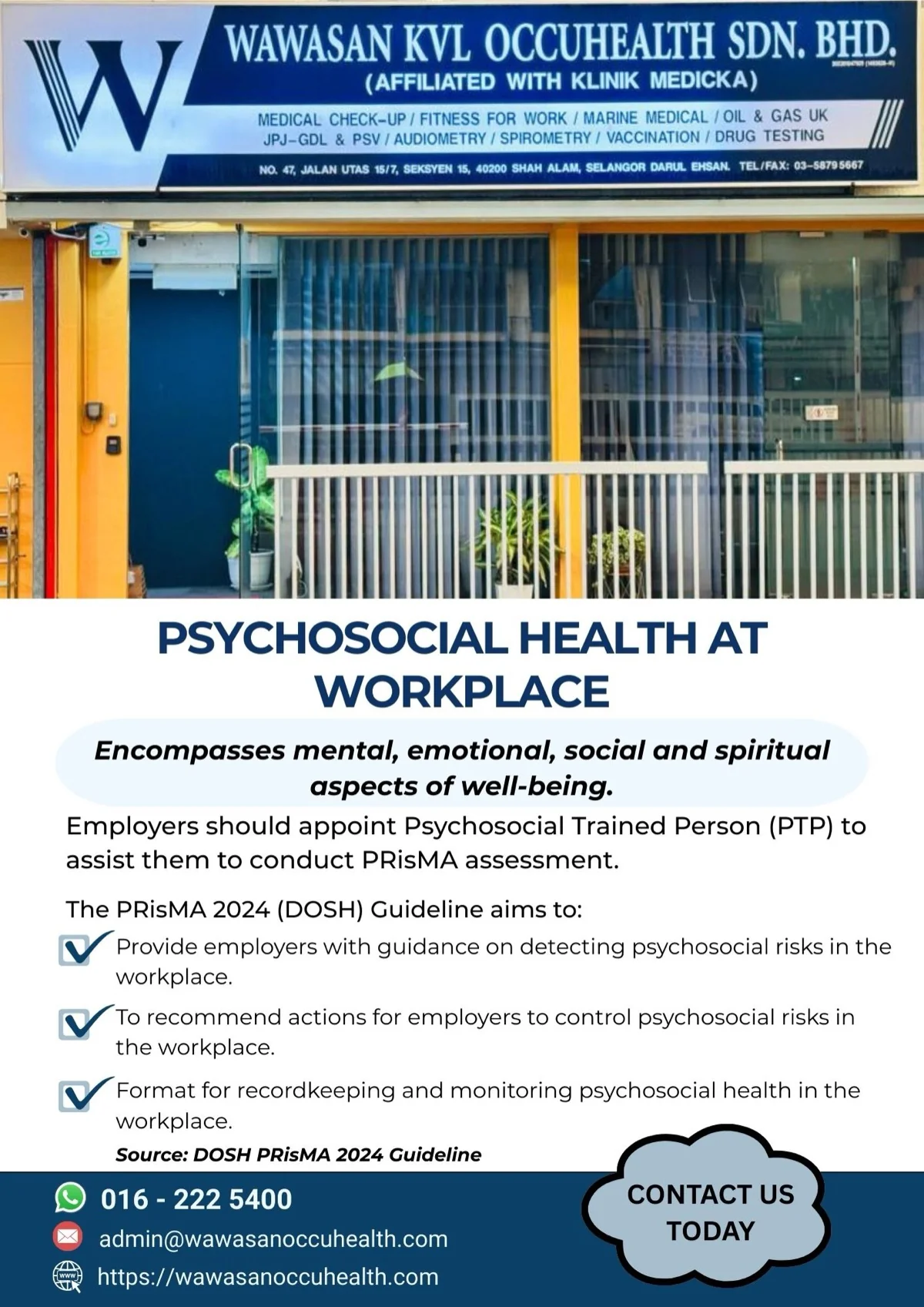
Psychosocial Risk Assessment at the Workplace: Understanding PRisMA 2024
Psychosocial risks are workplace factors that can affect employees’ psychosocial health. They can arise from how work is designed, organised and managed.
In Malaysia, the Department of Occupational Safety and Health (DOSH) published the Guidelines on Psychosocial Risk Assessment and Management at the Workplace 2024, commonly referred to as PRisMA 2024. The guideline provides a structured approach for identifying, assessing and managing psychosocial risks at the workplace.
What is PRisMA 2024?
PRisMA 2024 provides a structured process for identifying, assessing and managing psychosocial risks at the workplace.
The PRisMA assessment focuses on three main areas:
- Job Control
- Work Demand
- Job Support
These areas form the basis of the PRisMA psychosocial risk assessment process.
How does the PRisMA assessment work?
The PRisMA process includes identifying psychosocial hazards, assessing existing controls, prioritising risks and implementing appropriate risk management measures.
The guideline also provides a structured process for reassessment and recordkeeping.
This allows employers to move beyond simply identifying that employees may be experiencing stress and instead examine the workplace factors that may contribute to psychosocial risk.
PRisMA assessment tools
PRisMA 2024 includes specific tools to support psychosocial risk assessment and management.
LEO26 is a 26-item psychosocial risk assessment screening tool. It assesses the likelihood that the workplace environment and work activities may affect an employee’s psychosocial health.
EPC23 is a 23-point Employer Risk Management Checklist. It guides employers on actions to manage psychosocial risks based on the LEO26 assessment results.
The guideline also provides a PRiMA Psychosocial Risk Management Action Plan with suggested actions covering areas including social support, working environment, job matching, training and education, transparency and fairness, control and workload.
Role of the Psychosocial Trained Person
DOSH’s PRisMA 2024 guideline provides for the involvement of a Psychosocial Trained Person (PTP) in the assessment process.
The PTP assists with the PRisMA process, including psychosocial risk identification, assessment, risk prioritisation, management, reassessment and recordkeeping.
Why is psychosocial risk assessment important?
Psychosocial risk assessment is not simply about identifying employees who are stressed.
The focus is on identifying workplace conditions and factors that may create psychosocial risks, assessing the level of risk and determining appropriate control measures.
A structured assessment can help employers identify areas requiring attention and develop appropriate workplace actions based on the assessment findings.
Key takeaway
Psychosocial risk assessment focuses on the workplace factors that may affect employees’ psychosocial health — not simply on individual employees.
PRisMA 2024 provides Malaysian employers with a structured framework for assessing and managing psychosocial risks through Job Control, Work Demand and Job Support.
Source: Department of Occupational Safety and Health (DOSH), Guidelines on Psychosocial Risk Assessment and Management at the Workplace 2024 (PRisMA 2024).