
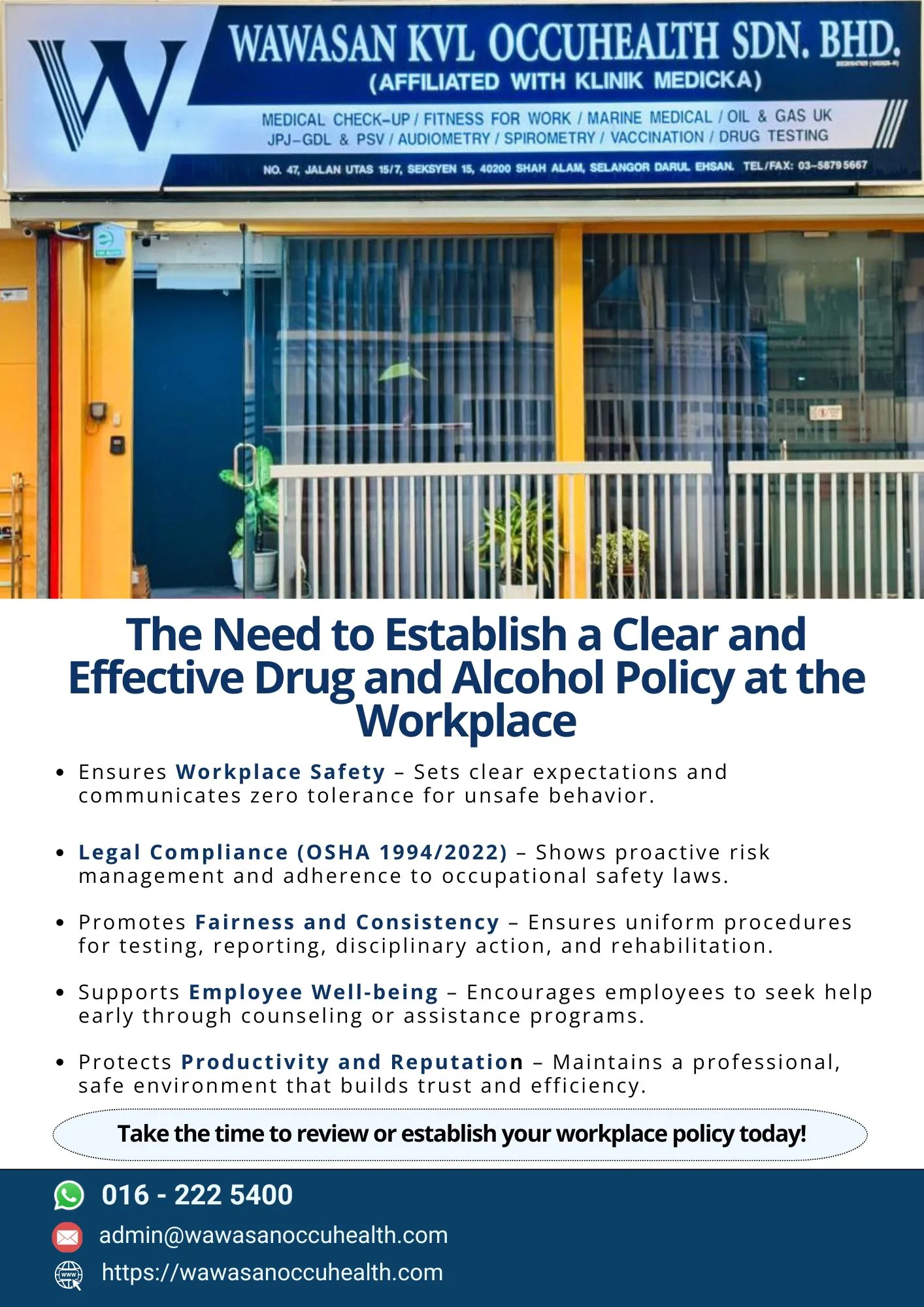
Workplace Drug and Alcohol Policy: Why It Matters for Workplace Safety
Drug and alcohol use can create significant safety and health risks in the workplace, particularly when it affects an employee’s judgement, concentration, coordination, alertness or ability to perform their duties safely.
For employers, having a clear workplace drug and alcohol policy provides a structured approach to preventing and managing these risks. The policy should clearly communicate workplace expectations, responsibilities and the procedures to be followed when concerns arise.
The Department of Occupational Safety and Health (DOSH) Malaysia also recognises drug and alcohol-related impairment as an occupational safety and health concern when it affects a person’s ability to work safely.
1. Supporting Workplace Safety
A clear policy helps employees understand what is expected of them and why drug and alcohol use can create risks at work.
This is particularly important in workplaces involving machinery, driving, working at height, hazardous substances or other safety-critical activities.
The aim is not simply to identify substance use, but to reduce the risk of accidents, injuries and unsafe work practices.
2. Supporting Legal and Regulatory Responsibilities
Under The Occupational Safety and Health (Amendment) Act 2022, employers have responsibilities to ensure, so far as is practicable, the safety, health and welfare of employees at work.
DOSH guidance specifically addresses the prevention and management of drug and alcohol problems in the workplace and highlights the responsibilities of both employers and employees.
3. Promoting Fairness and Consistency
A workplace drug and alcohol policy should establish clear and consistent procedures.
This may include:
- When testing may be conducted
- How employees are informed about testing
- How specimens are collected and handled
- How test results are managed
- What happens when a result requires further review
- Appropriate follow-up and support
Having documented procedures helps employers manage cases consistently rather than dealing with each situation differently.
4. Supporting Employee Well-being
A good workplace policy should not focus only on disciplinary action.
Where appropriate, employers can include access to counselling, employee assistance programmes, medical assessment or other support.
Early identification and appropriate intervention may help employees obtain assistance before substance-related problems lead to more serious consequences at work.
5. Protecting Productivity and Workplace Reputation
Drug and alcohol problems can affect more than workplace safety. They may also contribute to absenteeism, reduced work performance, accidents and disruption to operations.
DOSH’s guidance notes that effective workplace prevention and management programmes can help reduce workplace problems associated with drug and alcohol use and support productivity.
What Should a Workplace Drug and Alcohol Policy Include?
A practical policy should clearly define:
Purpose and scope Who the policy applies to and what the organisation is trying to achieve.
Prohibited conduct Clear expectations regarding the use, possession or being under the influence of alcohol or drugs at work, where applicable.
Testing procedures When testing may be required and how testing will be conducted.
Confidentiality How employee information and test results will be handled.
Response to positive or non-negative results Clear procedures for further assessment, review, confirmation and appropriate follow-up.
Support and rehabilitation Where appropriate, pathways for medical assessment, counselling or rehabilitation.
Drug and Alcohol Testing as Part of a Workplace Programme
Drug and alcohol testing can form part of a broader workplace drug and alcohol programme, but testing alone is not a complete policy.
An effective programme should combine a clear policy, appropriate testing procedures, proper specimen handling, suitable laboratory analysis and appropriate follow-up.
DOSH currently continues to list its Guidelines on Preventing and Responding to Drugs and Alcohol Problems in the Workplace and the Code of Practice on Prevention and Eradication of Drug Abuse, Alcohol and Substance in the Workplace among its occupational health resources.
Building a Safer Workplace
A well-designed workplace drug and alcohol policy gives both employers and employees a clear framework for managing substance-related risks.
The objective should be to promote a safe, healthy and productive workplace, while ensuring that employees are treated fairly and that procedures are applied consistently.
At Wawasan KVL Occuhealth, in Shah Alam, Selangor, we provide workplace drug and alcohol testing services to support organisations with workplace drug and alcohol policies, employee screening and workplace safety programmes.